🇮🇳 Civic Responsibility & Nation: How Small Actions Create a Strong India


Are We Just Citizens… or Nation Builders?
What if the future of India is not decided in Parliament…
but in your daily habits?
What if nation-building doesn’t start with leaders…
but with you?
We often dream of a developed India — clean cities, safe roads, honest systems, equal opportunities. But the real question is:
Are we practicing civic responsibility in our everyday life?
Because a nation does not rise by speeches.
It rises by responsible citizens.
What is Civic Responsibility?
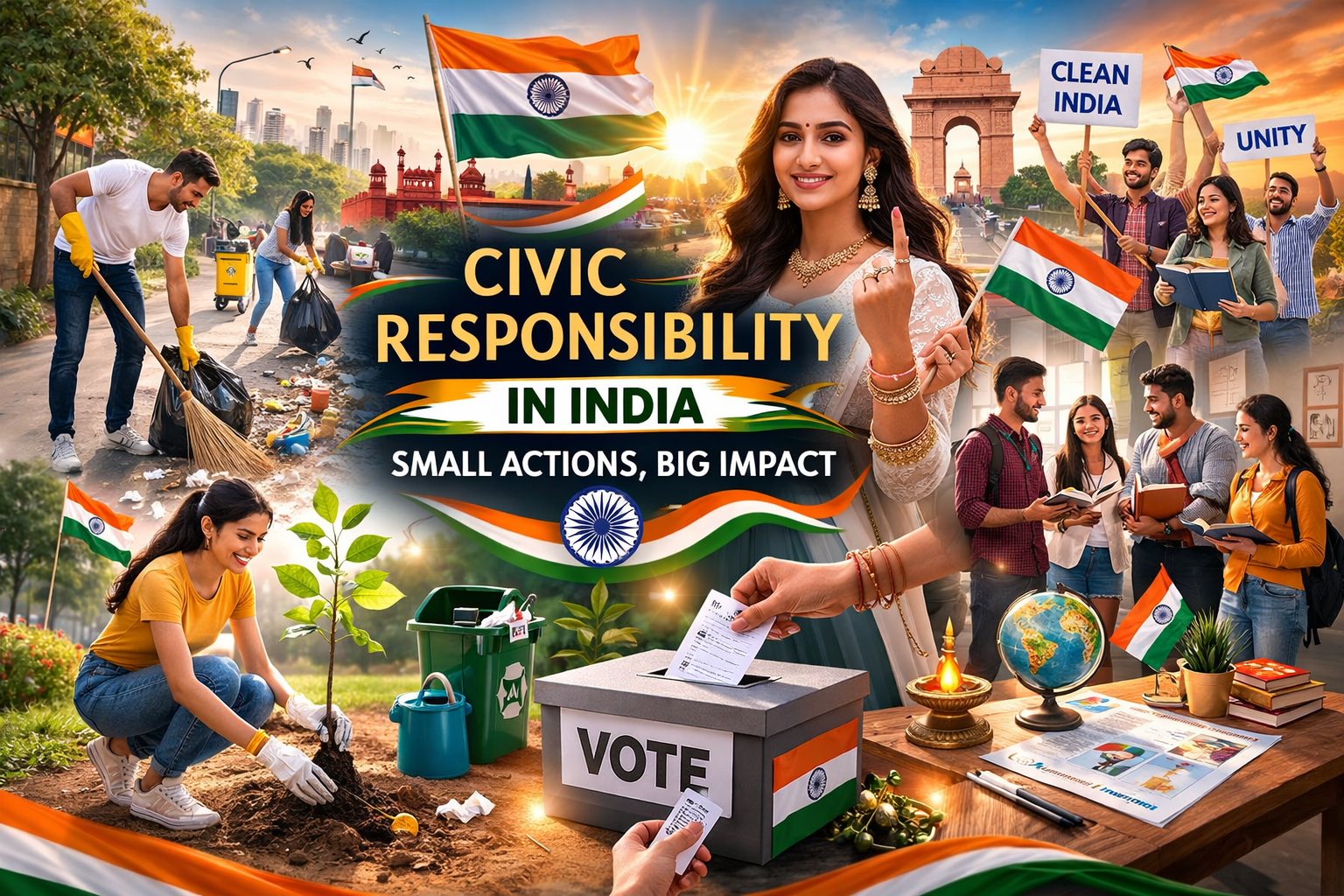
Civic responsibility means being an aware, active, and responsible citizen who contributes positively to society and the nation. It goes beyond symbolic patriotism and focuses on everyday actions that strengthen the country from within.
It is not limited to celebrating Independence Day 🇮🇳, posting patriotic content on social media, or simply talking about national pride. True civic responsibility is practiced daily — in small but powerful ways that shape our society.
Civic responsibility includes following laws and traffic rules even when no one is watching, voting wisely after understanding political issues, keeping public places clean, respecting diversity and equality, paying taxes honestly, supporting local businesses, protecting public property, and standing firmly against injustice.
In simple words, when citizens act responsibly, the nation becomes stronger — socially, economically, and morally.
The Funny Truth About Us (But It’s Not So Funny)
Let’s be honest.
We say:
“India should be clean!”
But sometimes we throw a wrapper and say,
“Ek hi toh hai… kya farak padta hai?”
We complain about traffic jams
But break signals when we’re in a hurry.
We say corruption is wrong…
But still look for shortcuts.
We want change.
But we wait for someone else to start it.
And now there’s even a trending reel line —
“Zero Civic Sense!”
We laugh when we see videos of:
-
People littering in public
-
Spitting on clean walls
-
Blocking ambulances in traffic
-
Writing names on historical monuments
-
Fighting over parking
We comment:
“Zero civic sense bro!”
We share it.
We tag friends.
We laugh.
But here’s the real question:
Are we only spotting zero civic sense in others?
Or are we checking it in ourselves too?
Civic responsibility is not a group assignment.
It’s not something we can copy from others.
It’s not a reel trend.
It’s a real-life responsibility.
It’s like a mirror —
If we improve ourselves, the nation reflects that change.
Because before saying “Zero civic sense,”
we must pause and ask ourselves:
Are we practicing 100% civic responsibility?
Real change doesn’t begin in viral videos.
It begins in silent discipline.
Why Civic Responsibility is Important for Nation Building
A nation is not just land marked by borders on a map. It is not only about geography, buildings, roads, or monuments. A true nation is built on its people — their character, their culture, their unity, their values, and their discipline. The strength of a country does not lie only in its military power or economic growth, but in the everyday behavior of its citizens. When citizens understand and practice civic responsibility, they become active contributors to nation building rather than passive observers of problems. A country grows stronger when its people choose responsibility over convenience, honesty over shortcuts, and unity over division.
Civic responsibility plays a crucial role in shaping the social, economic, and moral foundation of a nation. When citizens respect public spaces — parks, roads, government buildings, transport systems — they show that they value shared resources. Public property is not “government property”; it belongs to all of us. Damaging it or neglecting it weakens the country as a whole. Similarly, when people follow laws sincerely — not out of fear of punishment but out of respect for order — society becomes safer and more organized. Traffic rules, tax systems, voting processes, and civic regulations exist to create balance. When individuals ignore them for personal benefit, the entire system suffers.
Helping during emergencies is another powerful example of civic responsibility. Whether it is a natural disaster, an accident, or a social crisis, citizens who step forward to support others strengthen national unity. A nation becomes resilient when its people care for one another beyond personal interests. Supporting ethical businesses and local enterprises also contributes directly to economic nation building. When we choose businesses that operate honestly, treat workers fairly, and promote sustainable practices, we encourage a healthier economic environment. Responsible consumer choices shape markets, and strong markets strengthen the country.
Promoting social harmony is equally important. A nation as diverse as India thrives on unity in diversity. Respecting different religions, languages, cultures, and backgrounds creates social stability. When citizens avoid spreading hate, misinformation, or discrimination, they protect the emotional fabric of the nation. Division weakens progress, while unity accelerates it. Civic responsibility encourages dialogue, understanding, and mutual respect — qualities that are essential for long-term national growth.
Nation-building does not begin in government offices or political assemblies alone. While leadership sets direction, real implementation happens at the grassroots level. It begins in your home, where children learn values like honesty, respect, and discipline. It begins in your street, where you choose not to litter and encourage cleanliness. It begins in your college, where you engage in meaningful discussions, vote responsibly in student elections, and stand against unfairness. It begins in your workplace, where you act with integrity, avoid corruption, and contribute positively to your professional environment. Every small responsible action creates a ripple effect.
Development is often measured through infrastructure — highways, smart cities, technology, skyscrapers. While these are important indicators of progress, true development goes deeper. It is about mindset. A country with advanced infrastructure but irresponsible citizens cannot sustain growth. On the other hand, a nation with disciplined, ethical, and responsible people will continuously evolve and strengthen, even in challenging circumstances. Mindset determines whether public systems succeed or fail. If citizens adopt a mindset of accountability, cooperation, and awareness, national systems function efficiently.
Civic responsibility transforms individuals into nation builders. It teaches that rights and duties go hand in hand. We cannot demand better governance while neglecting our own responsibilities. We cannot expect clean cities if we do not maintain cleanliness ourselves. We cannot demand honesty in leadership if we tolerate dishonesty in daily life. True change begins internally and spreads collectively.
In essence, civic responsibility is the foundation of nation building because it connects personal behavior to national progress. Every responsible choice — no matter how small — contributes to a stronger, safer, and more united country. A developed nation is not built overnight, nor is it built by leaders alone. It is built gradually, through millions of responsible actions taken by ordinary citizens every single day. When individuals understand that their everyday conduct shapes the future of the nation, real transformation begins.
Youth Power & The Future of India 💪🇮🇳
India is not just a country with a large population —
it is a country with one of the largest youth populations in the world.
This is not just a statistic.
It is a responsibility.
More than half of our nation is young. That means the energy, ideas, innovation, and direction of India lie in the hands of its youth.
We are not just the future of India.
We are the present that is shaping the future.
Young citizens play a major role in nation development because our choices today decide what India looks like tomorrow.
Our:
-
Voice – What we speak about, what we support, what we stand against. When youth raise their voice for justice, equality, and positive change, society listens.
-
Vote – Voting is not just a right; it is power. A single responsible vote contributes to leadership, policies, and national direction.
-
Social media influence – In today’s digital era, one post, one reel, one story can shape opinions. We can spread awareness or misinformation. The choice is ours.
-
Creativity – From startups to art, from technology to content creation, young minds drive innovation. Creative ideas solve national problems.
-
Entrepreneurship – When young people start businesses, they create jobs, strengthen the economy, and support local growth.
Youth are not just participants in nation-building.
We are catalysts of change.
Patriotism: Beyond Slogans
Being patriotic is not about shouting slogans loudly once a year.
It is not limited to celebrations or trending hashtags.
True patriotism is quiet.
It is consistent.
It is responsible.
It shows in everyday behavior.
It’s about:
-
Not spreading fake news – Verifying information before sharing it. Understanding that misinformation can divide society.
-
Respecting women – Creating a safe and equal environment where every woman feels valued and protected.
-
Keeping surroundings clean – Understanding that cleanliness is not someone else’s duty. It is ours.
-
Supporting sustainable and ethical brands – Choosing businesses that care about society, environment, and values.
-
Standing up for what is right – Even when it is uncomfortable. Even when it is unpopular.
Real patriotism is not emotional excitement for a moment.
It is responsible action every day.
The Power of Responsible Youth
When young people choose responsibility, everything begins to shift. Corruption reduces because honesty becomes normal. Awareness increases because informed youth question, learn, and think critically. Innovation grows when discipline and hard work replace shortcuts. Society becomes more inclusive when the next generation values unity over division and respect over prejudice. And step by step, the nation becomes stronger.
The future of India does not depend only on policies or political promises — it depends on mindset. If young people choose discipline over shortcuts, truth over misinformation, unity over division, and responsibility over excuses, India will not just develop — it will lead. Because real patriotism is not loud; it is lived every single day. And the strongest nation is always built by responsible youth.
The Serious Reality
Let’s pause for a moment and think honestly.
We often say, “The government should fix this.”
“The system is not working.”
“Leaders should do something.”
But here is the serious reality: a developed nation is not built by the government alone. Yes, policies can guide the direction of a country. Yes, leaders can inspire people with vision and decisions. Yes, systems can create structure and order. But none of it truly works without responsible citizens. A country is not run only by ministers and officers — it is run every single day by ordinary people, by us.
Every time we follow a rule even when no one is watching, refuse to give or take a bribe, help someone in need, respect women and elders, keep our surroundings clean, speak up against injustice, or choose honesty over convenience, we strengthen the foundation of our nation. These actions may seem small in the moment, but together they shape the character of a country.
If we truly want clean cities, we must stop littering. If we want safe roads, we must follow traffic rules. If we want honest systems, we must reject corruption in every form. If we want equal opportunities and social equality, we must treat everyone with fairness, dignity, and respect. Change does not arrive in one dramatic moment — it grows through thousands of small, responsible decisions made daily.
Civic responsibility cannot be remembered only on national holidays or expressed through speeches and social media posts. It must become a habit, a mindset, a lifestyle. Because the truth is simple yet powerful: the nation is not “they.” It is not some distant authority or abstract idea. The nation is us — our choices, our discipline, our honesty, our kindness, and our courage.
When millions of small, responsible actions come together, they create massive transformation. Small actions create big impact. Quiet responsibility creates powerful change. Conscious citizens create a developed nation. And the future of our country is not written in stone — it is written every day by what we choose to do.
Final Thought: The Nation Begins With You
A better India is not just a dream we talk about on national holidays or post about on social media. It is a decision — a conscious, everyday decision. A decision to follow rules even when no one is watching. A decision to respect others regardless of their background. A decision to act responsibly in small situations that may seem unimportant but collectively shape our nation. Nation-building does not happen only in government offices or big conferences; it happens in our daily habits, our mindset, and our actions.
When we choose honesty over shortcuts, cleanliness over convenience, unity over division, and awareness over ignorance, we contribute to something much bigger than ourselves. Every responsible act — no matter how small — adds strength to the foundation of our country. Because when citizens shine with responsibility, discipline, and integrity, the nation shines brighter with progress, pride, and possibility.
At Velourha, we believe that style is powerful when it carries purpose. True beauty is not only about what you wear — it is about what you stand for. When you choose values, awareness, and responsibility, you don’t just represent yourself; you represent your nation.
Velourha – Wear Your Values. Wear Your Nation.

Leave A Comment